Global College
Programs and Reviews
Global College provides interactive programs geared towards students that are socially conscious and intellectually curious. Students can develop their own course of study in the disciplines of humanities and social sciences. Excursions and field trips are an integral part of each experience, as well as some internship opportunities. Over the course of the trip, students will learn how to prepare for a lifetime commitment to global citizenship, service and diplomacy.
Programs Abroad
Reviews
100%Overall
Rating
90%Overall
Rating
My name is Carly, and this is my third year with the program. I have studied in Costa Rica and South Africa, where I currently am. I am really interested in the arts, and creative processes, and their ability to transform communities of people through social action outlets. Backing up a bit, when I was around eight, I found this series of black and white prints that my Mom had shot, while studying at Evergreen, of homeless people in Pioneer Square, Seattle. (Where I grew up) I remember just sitting with them in our damp unfinished basement, marveling in the ability they allowed me to just stare in wonder at their subjects, people who I had never felt as comfortable looking at or studying before.
I come from a family of artists, and my youth has been partially filled with the search for ways in which I can satiate my creative energy while contributing to my global community, more than just aesthetically. Photography has been my ends to this search for the past three years.
Dorothea Lange, a famous photographer who caught many famous images from America's great depression said: "The camera is an instrument that teaches people how to see without a camera." This is a quote that I am diving into my project this semester with. I have dabbled in documenting, portrait, and commercial shooting, but what I really think is going to change the world around is not an exclusive group of elite photographers, but a population of people who have been taught to see by exploring their world with a camera.
This semester I will be teaching a black and white photography course to high school students from a poorer Durban school and a richer one together. We will be working from a self explorative curriculum with the idea that photography and education can together be a means to combat the misunderstanding that is bred by gentrification.
I will also be working to implement a weekend arts education program to marginalized youth from poorer townships and informal settlements around Durban. I am working with an organization called Ikamva Youth, out of Durban, that tutors these high schoolers one to three times a week, to help them pass their final 'senior or metric' exams. Every Saturday I meet with the kids, sometimes with a guest speaker from the Durban arts community, and present a new way to exercise our right brains.
Lastly, I will also be working with the Durban branch of the Right2Know campaign. I am currently in the process of organizing an interactive and traveling photo booth/exhibition with them, that will encourage younger participants to join the fight against the secrecy bill that is currently being passed though legislation.
So there is my semester in a nutshell. Global College is a unique program with a ton of independence for the dedicated self-educator, and I would recommend the program to any self disciplined learner with a desire for global citizenry.


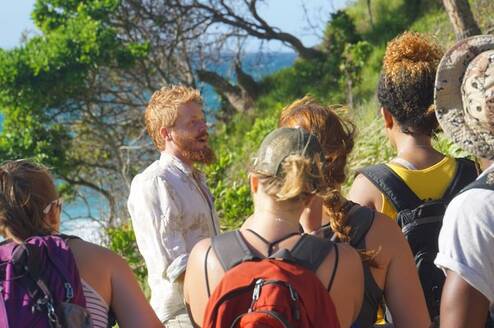


At LIU Global, I was exposed to the intrinsic beauty of South Africa through their Durban Center in the fall of 2010. Initially I made the decision to go to South Africa because I had become very attached to this giant majestic monster, the ocean. When preparing to leave for Durban I spent most of my time: applying for my visa, packing swimsuits, and working to save enough money to buy a surf board upon arrival. Once in the country I was immediately shocked with the amount of new luxury cars in the airport parking lot. I was not expecting to ride home on an elephant, but I had figured: this is Africa, I most likely will not be getting a ride to my new home in a Mercedes.
The most important thing I would note about South Africa is its wealth. South Africa has gold, diamonds, oil and other rich natural resources. These resources, along with the 'misappropriation' in government funds make some South African's extremely well off, and more South Africans extremely poor. But as I have come to learn in life wealth is not solely about money, and this is where South Africa holds most of its riches, in culture. South Africa is a country with 11 official languages, and many different cultures within what was titled by Nelson Mandela 'The Rainbow Nation'. This diversity and South Africa's status as one of the continents most quickly developing nation, gives the traveling student ample learning opportunities.
The other day in one of my classes at the LIU Global, Brooklyn campus I was reminded that there are two main different types of cultures: doing and being. America is a good example of a doing culture, where we measure our successes in life on how much we accomplish. South Africa is very much a being culture. I don't exactly know how one best prepares for this aspect of culture shock, but it is a good thing to think about before you choose where to go, and especially before you end up in your location of study. This difference between doing and being had the biggest significance in an independent study I pursued in South Africa titled Point and Shoot. The program was a youth empowerment through photography program that looked to increase the pathways of communication within youth in a public and private school in Durban. What being culture meant to this program was inconsistency in students time management and when they decided to approach various assignments on the lesson plan, in addition to how much time they decided to take completing them. In a being culture it is interesting to investigate how much you will be able to quantifiabl-ly get done in relation to how much you will be able to qualitatively complete.
Lastly, as much as you can break down and dismantle as many Africa stereotypes you can before you arrive in South Africa. Most likely friends and family will urge you to study abroad in 'safer' locations, such as England or Australia. Don't believe everything you read or are told. Bad things can happen anywhere, and while they might be more prevalent or recorded more in South Africa, I lived there for 10 months and never experienced direct assault or crime of any type. Like anywhere you travel, one must just be aware and street smart. Talk to the locals at campus, gather their ideas on what is safe and what isn't. Some things I have learned from experience are: don't go out alone after dark (there is no such thing as safety in numbers at nightfall), don't flaunt your monetary possessions, do trust in the good nature of humans, don't let fear consume you. LIU Global is a program that I would encourage all students interested in study abroad to look into: http://www.liu.edu/Global.aspx. Additionally, if you are ever presented with the option of going to South Africa, never doubt the decision to go for a minute.