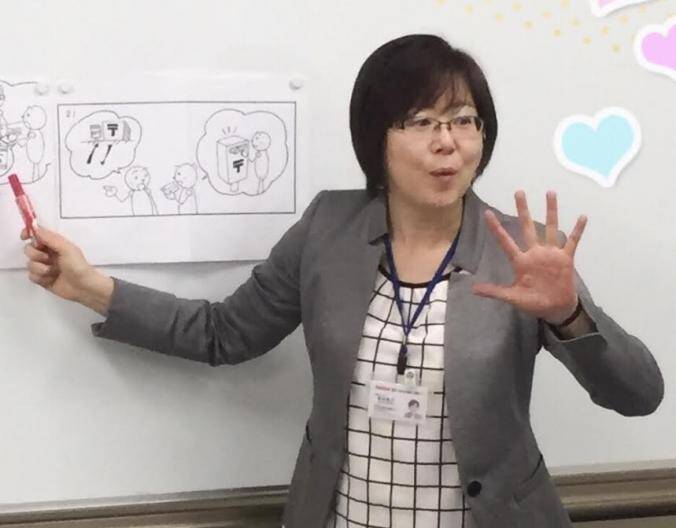
The main reason for becoming a teacher was that I had heard of children of foreigners in Japanese schools who were taking classes but couldn’t understand Japanese.
Although, I had never personally taught in elementary or junior high school, I was aware of this situation where students were stuck in a classroom where they understood none of the language, and realized how taxing that could be.
I wondered if there was anything I could do to help. It was at that point that I decided to become a Japanese teacher.
What has been your happiest moment as a teacher?
Every time my students finally grasp the meaning of what I am trying to teach them and when the students thank their teachers for all their hard work.
Japanese people especially feel very gratified upon being thanked. To us there is an underlying spirit in that very simple gesture.
For us to carry out our job and then be thanked for it is a good feeling for us as teachers and something that we treasure.
What is the thing you most look forward to when you wake up in the morning?
When I wake up every morning, the thing I look forward to is going to YAMASA - seeing the students, the teacher’s smiles, and how they are feeling. It’s something I really look forward to.
What is the philosophy behind YAMASA?
Our philosophy is based upon six promises that we make to our students which are also shared by the larger Hattori Group (YAMASA’s parent company).
The focus of these promises is the students, then broader society and all staff members. That is what we aim for as a school.
Ideally, what should students be able to do when they leave YAMASA?
Of course, the most important thing they should be able to do is speak Japanese!
The other thing students who study at YAMASA should be able to do after graduation is say that they enjoyed their time at YAMASA but also to have fallen in love with Japan as a country.
This means different things for different people. Some may fall for the culture and some may enjoy the people. I want them to see the best of what Japan has to offer.
How does YAMASA serve the learning needs of the students who study there?
As one might expect, different students have different needs. We like to keep tabs on where our students are at by issuing surveys during the course and at the end of each semester.
By doing this we can get a good grasp on what our students are thinking and what they want to achieve which gives us new ideas to make our existing courses even better.
What type of impression should students have of YAMASA when they leave?
I would like students to be eager to return when they graduate. If this is a place they ultimately want to learn in then I am happy.
Studying here is a small part of one’s life but we would like them to treasure the memories they have of Japan. When they go home to their home countries, I’d love it if they thought of it as their home in Japan thanks to the time they spent at YAMASA and in Okazaki.
Lots of our students say this when they make their final speeches at their graduation ceremonies, and I like to think this is the case.