

Why did you choose this program?
I chose this program because I wanted an intensive Chinese language course in a large city, but not one as overwhelming as Beijing or Shanghai. The school supported me with accommodation and my student visa, arranged airport pickup, and helped me settle into daily life in Qingdao by assisting with a SIM card, bank account, and essentials. With additional branches in Hangzhou and Chengdu, I can also see myself continuing my studies at their other locations.
What did your program provider (or university) assist you with, and what did you have to organize on your own?
My university acknowledged my plans by signing the required forms, but their support was otherwise limited. I independently researched, applied to, and was accepted by the language school, and I also organized my own travel and accommodation. However, the university did provide partial financial assistance toward my travel expenses.
What is one piece of advice you'd give to someone going on your program?
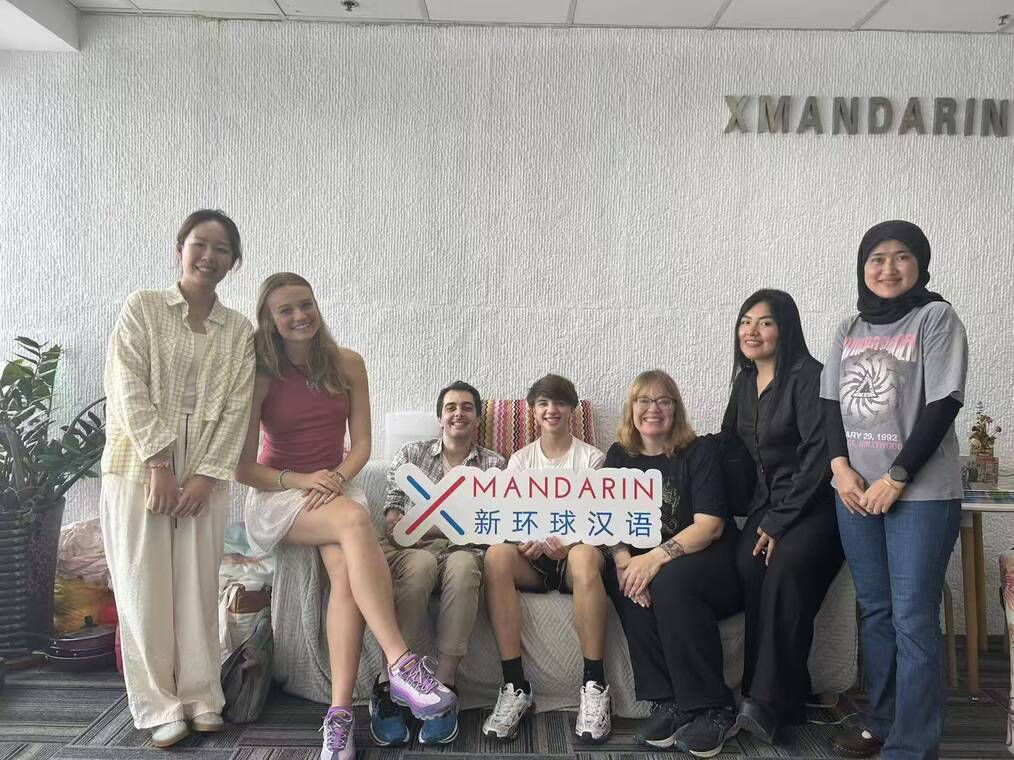
For anyone considering XMandarin Language Schools in Qingdao, Chengdu, or Hangzhou, the experience largely depends on the effort you put in. If you prefer close guidance, private lessons may be the best option. However, if you need constant pressure to study, this might not be the right fit—while there is homework, self-discipline is key, especially when learning a tonal language. Group classes are small and interactive, offering the focus of private lessons but with the added support of classmates.
What does an average day/week look like as a participant of this program?
I attend small group classes three times a week at XMandarin Chinese Language School in Qingdao, with each two-hour session totaling six hours of in-person lessons per week. Before class, I usually grab a coffee from XMandarin’s free coffee and tea station, and after class, which is finished by 1:00, I go for lunch with fellow students and sometimes the teachers at one of the many affordable and yummy restaurants nearby.
Going into your experience abroad, what was your biggest fear, and how did you overcome it? How did your views on the issue change?
This was my first time in Asia, and I was nervous about moving to Qingdao without a community or any prior experience living in China. With no Chinese background (HSK 0), I worried about making friends and even something as simple as ordering food. To my surprise, those turned out to be the easiest parts of the experience. Within a few weeks, I met amazing people (after all, it takes a certain kind of adventurous spirit to move to China to study Chinese). Now, we spend our time exploring new restaurants, enjoying nights out, or relaxing in cat cafés, malls, or along the waterfront.
Chinese is a tonal language, which means the rise and fall of your voice can completely change a word’s meaning. Some words look identical in pinyin but mean very different things depending on tone. Getting tones wrong is just part of the learning process—but sometimes the mistakes are hilarious. For example, bāozi (steamed dumpling) sounds dangerously close to a curse word if you mess up the tone. So yes, I’ve accidentally sworn at shop workers while trying to order lunch. Thankfully, they just smile. But among my friend group, I haven't lived down the moment of cursing at the nice lady I bought Chinese dumplings from.