Child Family Health International

Child Family Health International Reviews

Kenneth
5/5
Yes, I recommend this program

Guayaquil and Puyo Ecuador: Diverse and Interesting experience

I spent a month is Ecuador in April 2017

I’m a physician with a great deal of clinical and administrative experience and am also a graduate of the Michigan School of Public Health. Because of this, I’m probably not very typical of the majority of folks who are reading this but for a few, my comments may be helpful. I was most interested in population health, delivery systems and vector control. I also hoped to do something that might contribute to the place I was visiting. Finally, I wanted the opportunity to have meaningful conversations with people in Spanish.

The month I spent in Ecuador was more than I could have hoped for. This was in large measure due to the programmatic flexibility of the sponsor and my assigned preceptor.

My first two weeks were spent in Guayaquil. The first week was weighted toward language classes with a couple of mornings visiting a local clinic. The next week was spent with vector control with some afternoon language classes. This was a good balance of time. I would say that the language school was more conversational and less structured than the school I attended in Oaxaca on a different trip.

My time with vector control was terrific. I was able to observe a highly organized and effective program on the ground. Wilfrido (my preceptor) is the vector control officer of a program that is responsible for diminishing the threat posed by mosquito bone illness (dengue, zika and chikungunya) in a huge, economically depressed area of Guayaquil that includes 500,000 people. I went out with the home visiting crew who charmed their way into most homes and provided personal and high quality education. I also spent time with the fumigation team and had the opportunity to see many different barrios, some of which don’t have basic water and electrical services.

Before going, I read a good deal about how tough Guayaquil can be and I had some anxiety. My preceptor who also hosted me not only kept me secure but also made me feel comfortable in that environment. They often provided transportation and gave careful advice on how and where we should go.

The second two weeks were spent in Puyo, a much smaller town on the edge of Amazonia. Because Puyo is at about 3000 ft above sea level, the weather was very comfortable with thundershowers almost every day and just a bit of heat for a couple of hours in the afternoon. Folks told me that there really isn’t a dry season in Puyo. It is about the same all year around. (Guayaquil does have a wet season and a dry season with May being variable.)

During my two weeks in Puyo, I was able to work on a project in which the local medical care community and hospital are trying to implement a major program advancing the care of type 2 diabetes. The Ecuadorian Ministry of Health has recently released a set of guidelines and I happened to arrive during a time of intense planning. My fellow participant and I were able to develop a set of recommendations that we discussed and modified with the help of community members and medical personal. I believe that this work will contribute to the eventual success of the program. This was more than I hoped for and we were supported fully by Child Family Health International.

Additionally, I was able to visit San Virgilio for a couple of days. This was an experience of a lifetime. I stayed in a comfortable bungalow that was in close proximity to members of an extended family. My host, Rodgrigo kept in almost constant contact with me and thought of everything, including providing a walking stick to help with stream crossings and slippery slopes. You are actually driven to the main village and do a bit of walking to get to the family compound (you cross the stream twice). You do need to purchase rubber boots but that is easy to do at the Mercado in Puyo and it costs about $10.00. I was introduced to Kichwa culture and tradition in a genuine way. By the way, the meals I had in San Virgilio were the most interesting I had on my trip. Amazingly enough, there were no mosquitoes! (Because I am older than 58, I chose not to be vaccinated for yellow fever). Rodrigo told me that there are mosquitoes during the “drier” months of July and August.

I feel particularly fortunate to have stayed with my preceptor, his wife and their two children during my two weeks in Guayaquil. They were more than generous hosts. It felt like I was actually part of the family. Guayaquil was warm and humid and it was comfortable to be able to sleep in an air-conditioned room. My hosts for the second two weeks were also very generous and provided a very comfortable home during my two weeks in Puyo.

I had given no thought to weekends before leaving but this turned out to be an important part of the trip. I feel very fortunate that my companion during this month was a young woman who is just graduating from the University of Oregon. She was a courteous, flexible and interesting working/educational partner and traveling companion. We had the opportunity to visit Cuenca and Caja National Park, Latacunga and the crater lake called Quilotoa and of course Banos and the waterfalls (only an hour and one-half away). By the way, at this moment, Ecuador is a great travel bargain.

Thank you and CFHI for helping me have a remarkable experience.

A few additional thoughts:

1. I think a person with at least basic conversational Spanish competence will be able to take best advantage of the opportunities presented in Guayaquil and Puyo. I think a person wishing to be introduced to an “intensive” Spanish instructional experience might be better served at a different site.

2. I think a person interested in population and public health might find this experience exceptional, as I did.

3. This program demonstrated flexibility.

4. I studied almost all the materials provided and I suggest that participants take the time to do this as well. I had realistic expectations going in and this was important.

What would you improve about this program?
A bit more information before going about other participants and having the opportunity to discuss a few details with my preceptor
Madeline
5/5
Yes, I recommend this program

Cordoba, Argentina

I participated in a two-week Medical Spanish Intensive course in Cordoba, Argentina. The mornings consisted of rounding with Internal Medicine physicians in the hospital and the late afternoons were Spanish classes. We had plenty of time to explore the city, but also time to learn and improve our Spanish. We had a manual which I was impressed with about Argentinian culture as well as a Medical Spanish practice book. My housing was nice (there was no AC, but that is the case in all of Argentina and I had a fan). The cooking by the host mom was amazing (omg so good). We practiced Spanish every night with our host family (a mother and her 9-year-old daughter) and they were very warm and welcoming.
I worked in an infectious disease hospital and was exposed to diseases such as Guillan Barre, Chagas disease, psittacosis pneumonia. The doctors were all very nice. The hospital was different from US hospitals and it was pretty eye-opening seeing how healthcare is delivered in different settings.

What was your funniest moment?
I was struggling with figuring out the time difference even though it is pretty basic. Hours ahead...behind...we laughed a lot at lunch.
Read my full story
Tesiah
4/5
Yes, I recommend this program

2 Week Maternal-Child Health Intensive

I attended the 2 week intensive to Kabale, Uganda. I had an incredible time with the local Ugandan people. The staff and clinicians of Kihefo were so kind, welcoming, and willing to share their knowledge with us. They are doing such incredible and important work, the positive evidence of Kihefo is evidenced throughout Kabale town. The outreaches to local villages and visit to the traditional healer left a lasting impression.
The local CFHI coordinator Carol was exceptional and took really good care of us. The local staff such as Patricia made us feel at home. Patricia would make peanut butter from scratch for our breakfast, and was also a warm presence at meal times. I will definitely be returning to volunteer with Kihefo!

I also highly recommend doing the safari with Scodius, she is a incredibly tour guide!

What would you improve about this program?
I didn't feel supported as a Black woman on the trip, especially by the other participants. I would suggest screening participants more closely for understanding of cultural humility and racial justice.
Paulina
5/5
Yes, I recommend this program

Integrity, Personal, and Meaningful!!

I came across CFHI as a pre-med student - I wasn't sure what branch of medicine I wanted to study. All I knew was that I was interested in traditional medicine and women's health, and that I liked traveling. I approached their table at a pre-health conference and was insistently drawn into a rich conversation with them. My eyes were immediately opened by CFHI who taught me what global health entails, such as the social determinants of health and the importance of approaching a trip as a learner and observer of the local culture. Being aware of cultural boundaries. Responsible and ethical partnerships. After doing my research, I realized that these values were not common in other abroad programs. I decided that a trip with CFHI would lead to my personal, academic, and professional development and signed up.

Besides the obvious integrity of CFHI, what drew me to CFHI and continues to impress me is the genuine personal attention and sincere compassion towards their students. CFHI is a small organization, and it shows in their student interactions and intimate communication. I felt completely supported throughout the entire process. They want to help their students and make it easy. They encouraged me to apply for a scholarship, with fully funded my trip. The application process was straightforward, as it should be.

CFHI is furthermore unique among other "study/volunteer/work abroad" organizations because of its individual focus. Rather than joining a trip 'slot', you decide where you want to go, what focus you want to have, what specific clinics you want to shadow at, when you want to embark, and for how long. It is totally catered to make it worthwhile for the student, while also assuring the highest quality ethical partnerships with locals. Each day consists of a medical aspect and a cultural aspect, reinforcing the idea that health is more than just the doctor-patient dynamic.

My 6 week trip in Oaxaca, Mexico focused on Women and Maternal Medicine, Midwifery, Indigenous Medicine transformed me, and now I am pursuing to be an OB-GYN, a profession I never would have chosen if it weren't for the eye-opening perspectives I got from my CFHI trip. And for that I am forever grateful. Thanks CFHI for all the opportunities and integrity you are putting into the world.

Julia
5/5
Yes, I recommend this program

Humbling Uganda Experience

As a college student, I have to complete field experience in order to graduate. I had already completed the requirements for field experience but wanted to learn more about maternal health. So when I found at that Child Family International had a program dedicated to HIV and Maternal Health, I immediately jumped on the opportunity. I had the honor to receive a scholarship from CFHI which allowed me to go to Uganda. I chose CFHI because of their message of sustainable and ethical methods when sending students overseas. There are many volunteer programs out there but none with such a strong message. In the pre-departure packet, CFHI has students read about cultural competency, volunteerism, and even discussed the savior complex.

The program itself was an amazing experience. CFHI has a partnership with a local Kegezi clinic called Kihefo. The clinic has many departments so students who don't necessarily want to focus just on maternal health have the opportunity to shadow different departments. There is a dental clinic, an HIV/AIDS clinic, a maternal clinic, and a general practice clinic. As an aspiring midwife, I loved going to the maternal health clinic. There I learned how to measure/record a fetal heartbeat, measure how far along a baby is, and common complications. A big highlight for me was watching a live birth. It was amazing and something I would never forget.

The living conditions were very good. We received three meals a day and a water bottle for each meal. The Kihefo apartments are quite nice. There is not hot water all the time but it was totally worth it. The staff here is excellent and everyone is very supportive. I would caution LGBTQA+ students from traveling to Uganda as this is a conservative country. Overall, this was a good experience

What would you improve about this program?
It would have been nice to receive our projects the first week instead of the 3rd week we were here. The first two weeks were mostly shadowing.
Winnie
5/5
Yes, I recommend this program

Above and Beyond my Expectations

I came into my experience with Child Family Health International thinking that I would get some hands-on healthcare experience that would make me a better healthcare professional in the future. I came out of it with a new perspective on what health means and a trip that - although different than I was expecting and not "hands-on" - will truly make me a better, more culturally conscious and stronger global citizen and health advocate. 

Through CFHI, I learned to question my perspective and learn from local experts. I learned that health is not only the classes I took, the biological processes I studied or the hospitals I was familiar with, it is social, it is personal and it looks different to each of us. Healthcare in India is something that I am by no means an expert in, which is why I was refreshed that CFHI fosters a learning environment where participants are learners and local experts are teachers, guiding students through the intricacies of global health and social determinants of healthcare in different environments. 

Participating in the CFHI program in Delhi and Dehradun, India broadened my horizon and opened my mind to what it means to provide quality health care around the world, and I am forever grateful. Thank you CFHI!

Lake Bunyonyi
Eva
5/5
Yes, I recommend this program

The Pearl of Africa

Child Family Health International (CFHI) gave me the opportunity to give back to my motherland. I remember interviewing for Belmont's Pharmacy program and telling my interviewer that I would like to go back to Uganda for a month in my fourth year as part of my experiential education. It was a dream then, and now a reality. This was my first global health trip and it was definitely a life-changing experience. Robin and Ally were essential in setting up this trip and I am very grateful for all their help and tireless efforts. This is the first time Belmont University College of Pharmacy has had a rotation site in Uganda and the first Public Health//Missions elective that has lasted an entire month, and it was a great success. Several students are already interested in pursuing this elective in their fourth year and I hope I can return as a CFHI volunteer in the near future. As a person of color and from an underserved community, I was able to learn from first-hand experience of other social determinants that I had not personally experienced. HIV, malnutrition, poverty, and gender inequality are still a reality in many communities, including Kabale, Uganda I feel it is my role, as a global citizen, to start making the right changes as the world continues to change me. I like the Kigezi Healthcare Foundation (Kihefo) model because it integrates sustainable healthcare initiatives that fight disease, poverty, and ignorance. In Kabale, I participated in patient care in the general clinic (most common disease states include malaria, brucellosis, and typhoid), HIV/AIDS clinic, and maternal clinic. Besides my clinical experiences, I participated in gardening and visited a traditional healer for the first time. I learned more about how he incorporates spiritual, traditional, and western medicine. I also had the opportunity to visit the bishop that baptized me as a little girl (he moved to Kabale shortly after he baptized me and I had not seen him since then) and that made me feel like my spiritual circle is now complete. I have many questions after this trip, and I do not have all the answers, but I will continue to learn and be an advocate for quality healthcare for all. Thanks again CFHI and the Thomas Hall Scholar Award! #lettheworldchangeyou

Dana
5/5
Yes, I recommend this program

Hospital Medicine in Cape Coast

This experience was more than I could have ever asked for. The local coordinators made sure that you constantly felt safe and comfortable. They brought us around town and made sure we felt comfortable navigating around. If you ever had a problem they were more than willing to help out in any way possible and turned into great friends. At the hospital I was in the physical therapy department. The therapists were very kind and welcoming as soon as I arrived. They made sure to answer any questions I had and were eager to teach me about their profession and culture. The most interesting case I saw was a baby girl who was born with only a fibula in one leg. She was there for casting for club foot in her other foot but it was interesting to see the X-ray of her leg. I would definitely recommend putting yourself out there when at the hospital. Don't be afraid to ask questions, get to know the people working there & talk to the patients. There are great relationships that can be made by just talking with others. For me, this experience was unforgettable, but it really is what you make of it. Make sure to try new things, step out of your comfort zone, and build relationships with the people around you.

What would you improve about this program?
I think it would be nice if every group that stayed in the house wrote down in a journal the things they discovered while being there such as good places to eat, good places to buy souvenirs, or different places to visit. Every time a group leaves they should add to it so there are a lot of different options. It would also be nice if the volunteers could get a house key so they didn't feel like they couldn't leave if they didn't want to bother the coordinators.
Becky
5/5
Yes, I recommend this program

Great Learning Experience!

I went to Ghana last summer with a group of students from Stanford through the CFHI program. We went in with very little information, expecting to be on a service learning trip that turned out to be mostly a learning experience. However, as a learning experience, it was the best thing I could have done coming out of my freshman year. For eight weeks, I got to live in a foreign country (it was my first time leaving the US) and learn about a way of life I'd had no prior experience with. I was struck almost daily by the positivity the Ghanaian people so freely express, and by their dedication to their work. Throughout the entire experience, I learned invaluable lessons regarding my future path as a doctor, seeing the challenges the doctors in Ghana faced in bringing care to their patients.

What would you improve about this program?
If I were able to change anything, I would have wanted to know going in that the service aspect of the program was not going to be a major focus, as this was something that plagued me long after I returned home. I also would have wanted to be more connected to the people in the community outside of my small group of Stanford students and the staff that coordinated our experience.
Kelly
5/5
Yes, I recommend this program

Medical Volunteers Trip to Ghana

Journal excerpt from week three:
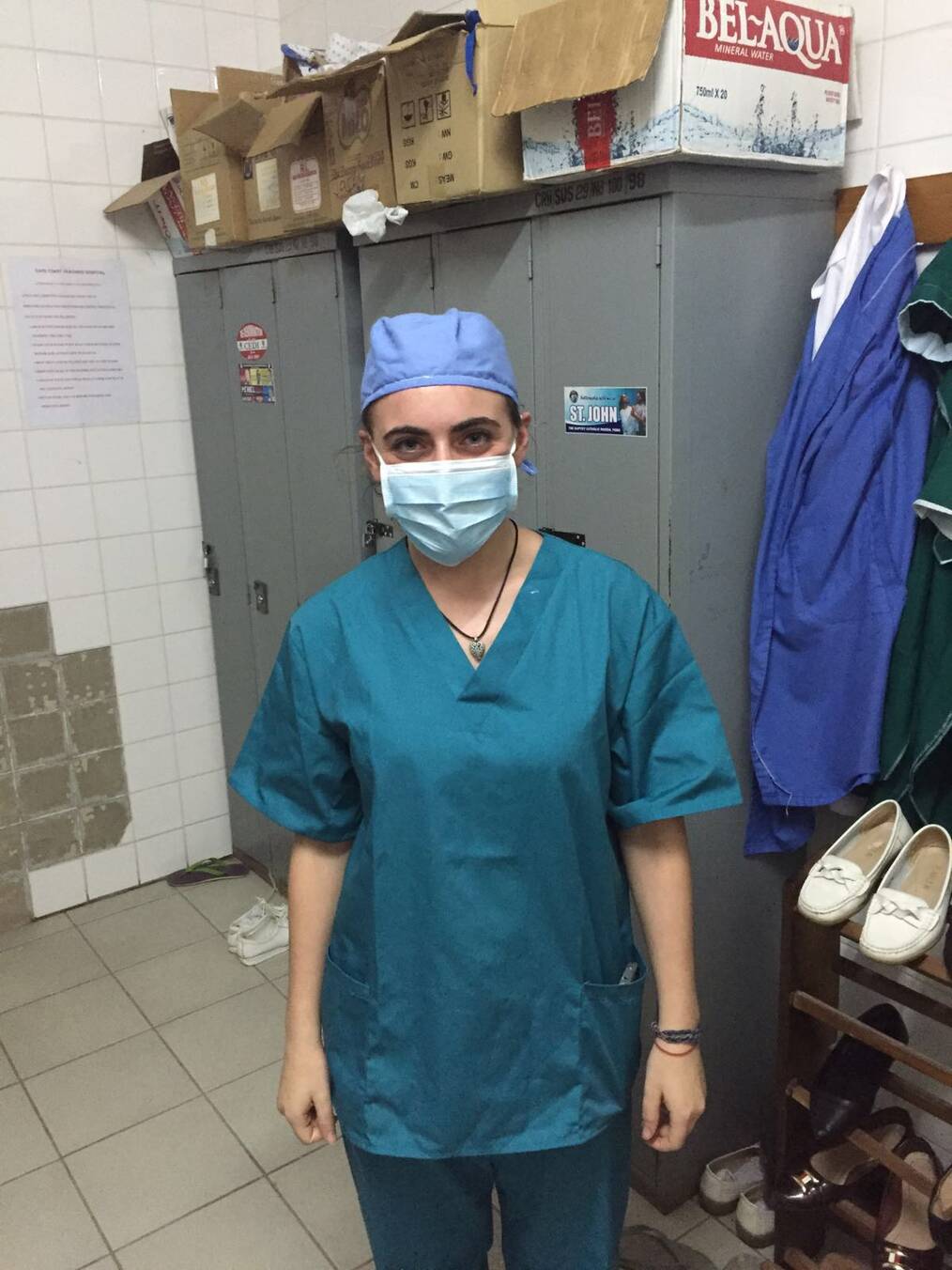
“The morning rays begin to peak through the window beside my bed. Off in the distance, I can hear the wild goats beating and the rooster that seems to crow at all hours of the day. As I look around me, I can see the others in the room starting to stir. I pull on my scrubs and join them in the main room for breakfast. Brittney and Basil are already at the table with the other volunteers mixing together the water and condensed milk. The peanut butter and crackers are passed around the table, and the bags of Crystal Water are packed for later in the day. After a quick discussion about what hospital department we plan to shadow, we grab our bags and head out the door. It is only 7:30 in the morning, but the air is already a bit warm. After a few futile attempts with our handkerchiefs to dry off the sweat, we begin the walk to the hospital, which is a little less than a mile. We are all anxious to return to our patients and check in with the physicians we shadow. Along the way, we briefly review the concepts we were instructed to study, such as the names of the metatarsal bones or the modes of healing. We have only been here a few short weeks, but have already grown to love working here in the hospital. As I make my way to A & E (Accident and Emergency Department), I am greeted by smiles from strangers calling out “Akwaaba” (meaning welcome). The people here are so genuine, it’s hard not to feel at home.” This program is an incredible opportunity for students hoping to learn about global health and the medical field. I have never had the opportunity to witness such hard work, compassion, and expertise combined. It renewed my passion for medicine and gave me a completely differest perspective on medical care. The physicians I worked with were incredible about showing me the process ad explaining how certain procedures were performed. It was an opportunity like no other for a pre-med student like myself. The highlight of my experience at Cape Coast hospital was scrubbing in to see a C-section and a baby being born for the first time. It was something I will never forget!
Home is exactly what it became for me. Living here for five weeks, I became a part of their community. I wasn’t just the outsider watching them from a distance. In a way, I was one of them. I was working side-by-side with them, eating the same foods, drinking the same drinks, and (in small sentences) speaking the same tongue. I learned about their cultural values, family customs, social interactions, and even their medical approaches. I think one of the most symbolic moments in embracing their culture, was when my house mother took us to Church with her. We got to attend weekly Mass with the community and at the end, they had a “birthday into the community” ceremony for Brittney, Basil, myself, and a few of the other volunteers we were living with. We were given our Ghanaian names at that ceremony based on the day of the week we were born. I became known as Esi. From that point forward, I had an instant connection with all other Tuesday born Ghanaians. I enjoyed feeling a part of their community and learning from their example.
We also had the privilege of having two a few local coordinators, Augustine and Roland, from the FEB foundation. These two were not only key to learning about this new land, but they also became good friends. They were so welcoming and excited to show us around town. We were incredibly lucky to have them. With their help, by the end of the trip, we knew the words to a few of their songs and had a snap in our handshake like the rest of Ghanaians.
The trip as a whole was an experience that I will never forget, and one that altered me in ways I didn’t expect. At first, I was definitely challenged to adjust to the cultural differences, unique living conditions, and cuisine options. I needed to learn how to adjust to bucket showers, water shortages, and regular power outages. Although I struggled at first to figure out ways to wash clothing or communicate back home, I soon developed new methods and learned to acclimate myself. I discovered how to wash entire loads of laundry in only half a bucket of water and shower using only a bottle of water. I then learned to translate these water conservation methods to cleaning bedpans and towels to help aid the patients in the hospital. Adjusting to life in a developing country became a challenging, but an enriching experience. It changes your entire perspective and doesn’t leave you once you return to the United States.
Things like the careful use of resources and respect for others were vital aspects of the Ghanaian community. There have been numerous times already since I have returned, that I find myself thinking how resources are being allocated, or how certain actions could be perceived. Since coming back, I have felt a bit frustrated at times with the disregard for the struggle of others. There are so many people here in the U.S. that cannot think beyond their next Starbuck’s latte, never mind the people that are struggling just to access clean water. It makes me realize that I want to be careful in determining where my priorities lie. I don’t want to spend my life concerned with trivial matters when I could be contributing to the livelihood of others. It solidified for me my passion for continuing outreach and medical care.
When I stepped off the plane as a Global Medical Volunteer, I realized I might never look at healthcare or cultural differences the same way. During my first week as a volunteer, I met a young woman who was a patient at Cape Coast Hospital in Ghana. She had a tumor obstructing her airway, along with a case of pneumonia. With each labored breath, I could hear her struggle alone in her room. Concerned by her state, I went to check her vitals. As I unwrapped the blood pressure cuff, she reached up and grabbed my hand. I squeezed her hand in return to let her know I was there. She looked up at me, surprised, and a small smile crept across her once distraught face. It was the first time I had seen her smile and was determined not to let it be it her last. When the doctors asked someone to check her vitals and nebulizer every hour, I readily volunteered. To lighten her spirits, I made smiley face balloons from the rubber gloves. When she passed away, my heart dropped. I realized, however, that her story did not end here; her hands would continue to work through me as I care for those around me. In those five weeks, I was not able to eradicate malaria or even suture a wound; however, I know the people of Ghana will be forever imprinted on me as I go forth into the medical field. I will carry the sense of community and compassion shown me, and use that to guide me as a future physician.
I know that as a future physician, this experience will forever shape how I treat my patients, how I practice medicine, and how I extend that care to others. I watched the physicians in Ghana take the time to listen to their patients, make them laugh, and to offer them a kind word. I have never met such devoted and self-sacrificing individuals, who often spent even their “nights off” living in the hospital. They rolled up their sleeves and treated each patient with extraordinary care that often when beyond the walls of the hospital. I hope to follow their model, and cherish the moments that allow me to improve another person’s quality of life, whether that be in terms of housing, medicine sanitation, resources, or emotionally. I have learned from the people there that we all have great capabilities for doing good. In choosing to support one another, we build a community that strengthens itself. This has significant impacts on each individual both emotionally and physically. One of the physicians at Cape Coast Hospital once said to me at the end of his 48-hour shift, “If I look back on my life someday, and someone received a second chance because of me, then my life was worth something.” Those are words I will never forget, and I believe will guide me as I navigate my way through life.
I am extremely grateful for this opportunity to join a completely different culture, and understand how living with limited resources doesn’t need to limit you as a person. I have learned more in these short five weeks than I thought possible. I learned about myself and how to manage in extreme settings. I have become more conscious of my respect towards others, especially those who are my elders. I have discovered that reaching out and simply saying Akwaaba, or hello, can brighten anyone’s day. Most of all, I have embraced the idea that everyone is your brother (or sister) and that you have a duty to yourself and to them to bridge that divide.

What would you improve about this program?
Helping incoming students understand the cultural practices in the community a bit more before coming abroad.